
The 2026 Greater Manchester mayoral election took place on 30 July, and was won by the Labour candidate, Bev Craig.
When Andy Burnham won the Makerfield parliamentary seat, a vacancy opened up for GM mayor, hence the mayoral by-election.
There will still be a mayoral election in Greater Manchester in May 2028, as originally scheduled.
The main polls (YouGov, More In Common, Find Out Now) predicted Labour winning the mayoralty, but with voting going to the second round because no candidate was expected to receive more than 50% of first-choice votes. The numbers were slightly off in all cases, but they got it broadly right.
In fact, all three polling organisations underestimated Labour’s vote share from the first-choice votes, but got the second round figures almost spot-on.
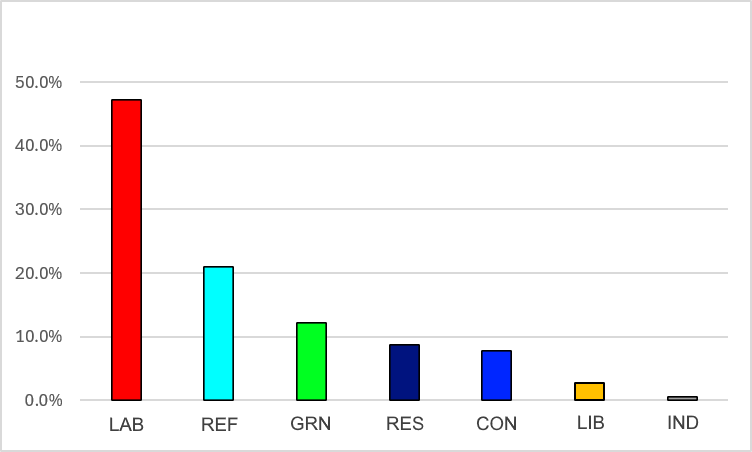
First choice votes
| Candidate | Party | 1st round votes | % of 1st round votes |
| Bev Craig | Labour & Co-op | 251,449 | 47.1% |
| Sian Niamh Astley | Reform UK | 111,928 | 21.0% |
| Geraldine Coggins | Green | 64,968 | 12.2% |
| Marlon Scott West | Restore Britain | 46,289 | 8.7% |
| Phil Eckersley | Conservative | 41,021 | 7.7% |
| Richard Martin Kilpatrick | Liberal Democrats | 14,702 | 2.8% |
| Marcus Jonathan Farmer | Independent | 2,969 | 0.6% |
From the first round of votes, Labour’s Bev Craig led with 47.1%. The Green hype seems to have died down a bit since the Gorton & Denton by-election, as Reform overtook them to take second place at 21%.
This is the first GM mayoral election in which second-choice votes have mattered. In previous years, an outright winner was declared after round one of voting because Andy Burnham consistently achieved over 50% of the vote in every mayoral election he stood in*.
*In 2024, the mayoral election used the first-past-the-post system, following reforms contained in the Elections Act 2022, but Andy Burnham still won 63.4% of the vote. The English Devolution & Community Empowerment Act 2026 allowed a return to the Supplementary Vote system for this year’s election.
Adding the supplementary votes

The result after counting all the first and second choice votes for the Labour and Reform candidates was:
| Candidate | Party | Total 1st & 2nd preference votes | % vote share |
| Bev Craig | Labour & Co-op | 309,525 | 66.3% |
| Sian Niamh Astley | Reform UK | 157,178 | 33.7% |
Vote share in different council areas
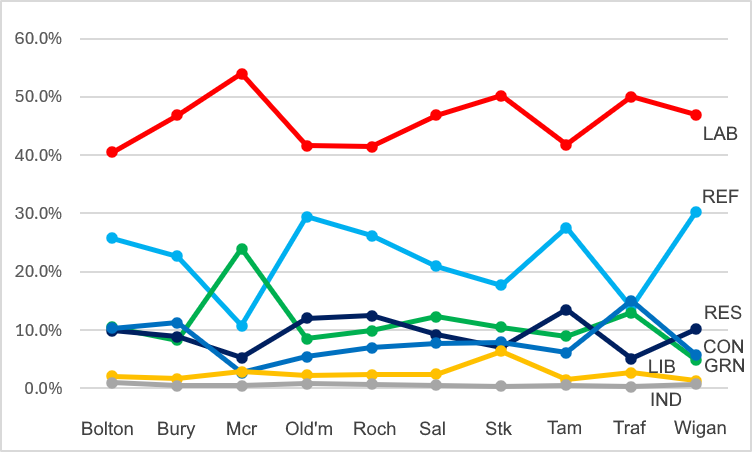
Labour was the highest-polling party over the whole region, but there were some notable variations between boroughs.
We can see from the graph below that the Reform vote share was inversely proportional to that of Labour, i.e. boroughs with higher numbers of Labour voters had correspondingly lower Reform votes, and vice versa.
While Manchester had the highest Labour vote, it also provided the greatest showing of Green voters. Other boroughs with Green local councillors saw a slight rise in Green mayoral votes, yet remained close to the mean GM Green vote share of 12.2%.
The Conservatives did poorly, with right-leaning voters split between them, Reform and Restore.
If we assign each of the parties to broadly left- and right-wing groupings (yes, we know it’s not that simple), there’s roughly a 2:1 ratio of left vs. right voting (LAB + GRN + LIB = 62.1%, CON + REF + RES = 37.4%).
Even if all of the right-wing parties had united under one banner, they would not have secured enough votes to beat the Labour winner.
The Liberal Democrats popularity on (some) local councils did not translate to the mayoral election, with them finishing as the worst-performing mainstream party across all council areas. Only in Stockport did they make a noticeable impression with voters.
Turnout
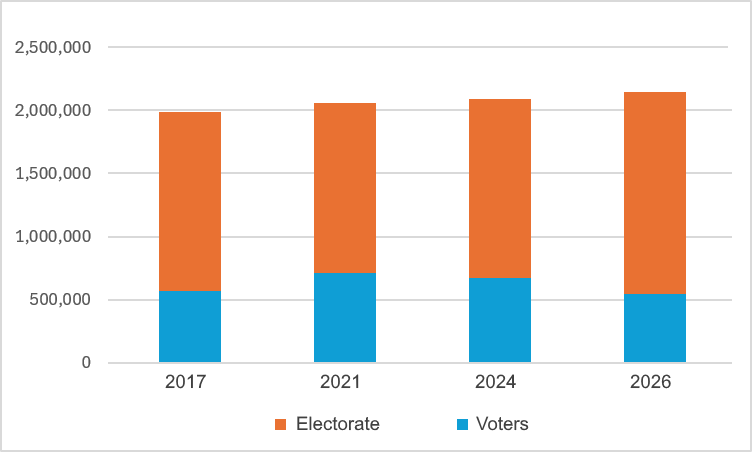
Overall turnout for this election was low, at 25.14%. Turnout has been low in previous years, but this is the lowest so far in a GM mayoral election.
Turnout was above 30% only in Stockport and Trafford, at 31% and 35% respectively.
| Year | Electorate | Turnout |
| 2017 | 28.9% | |
| 2021 | 34.74% | |
| 2024 | 32.05% | |
| 2026 | 25.14% |
Typically, turnout in both GM local elections and the general election is higher than this. In the 2026 local elections, turnout ranged from 25% in Tameside to 48.9% in Trafford. The last general election, in 2024, yielded a turnout of 59.7%.
Sign up to The Meteor mailing list – click here
The Meteor is a media co-operative on a mission to democratise the media in Manchester. To find out more – click here
Featured image: public domain image from Flickr

Leave a Reply